How to Set Boundaries Without Becoming Cold or Disconnected
Setting boundaries does not have to mean becoming cold or distant. This article explores how to combine warmth with firmness so you can protect your energy without losing connection.
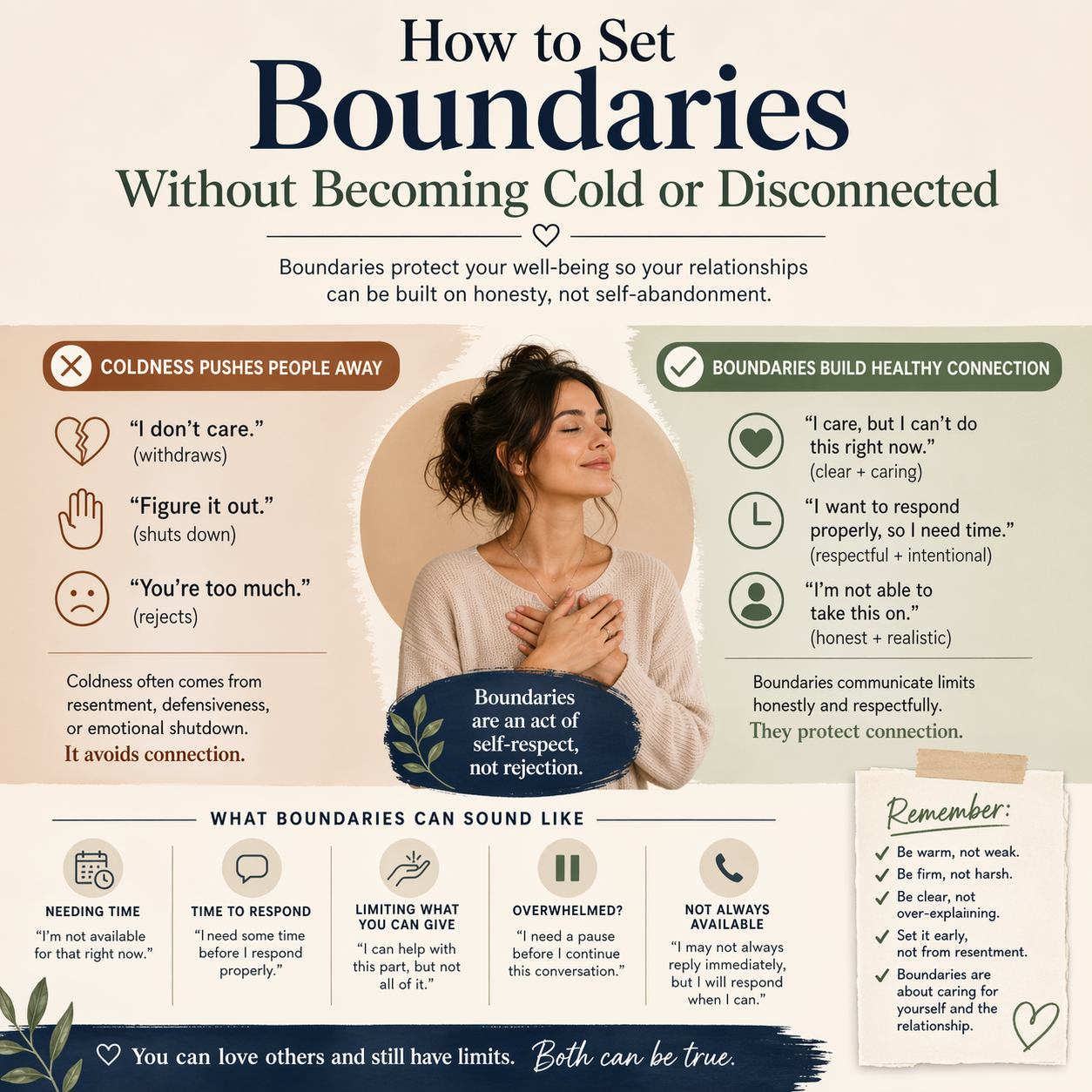
How to Set Boundaries Without Becoming Cold or Disconnected.
Many people understand the need for boundaries in theory.
They know they are tired of over-explaining, over-giving, staying available when they are already stretched, or saying yes when they really mean no. They know something has to change.
And yet, when it is time to actually set a boundary, a different fear appears:
“What if I sound rude?”
“What if I hurt them?”
“What if I become cold?”
“What if I change too much?”
This is where many people get stuck.
Because for a lot of people, boundaries do not just feel like limits. They feel like the risk of disconnection. The fear is not only about saying no. It is about what saying no might mean in the relationship.
But healthy boundaries are not the opposite of warmth.
They are what make warmth more honest, more sustainable, and less resentful.
Why boundaries get misunderstood?
Many people grow up learning that being good means being available.
▪️It means adjusting.
▪️Helping.
▪️Being easy to deal with.
▪️Not asking for too much.
▪️Not disappointing people.
▪️Not making things uncomfortable.
So when they begin to consider boundaries, it can feel as though they are becoming harder, harsher, or less loving.
But what is often actually happening is something much simpler:
They are becoming more honest about what they can carry.
Boundaries are often misunderstood because people imagine only the extreme versions:
-
being abrupt
-
cutting people off
-
becoming emotionally distant
-
refusing everything
-
sounding defensive or angry
But real boundaries are usually much quieter than that.
They often sound like:
-
“I’m not available for that right now.”
-
“I need some time before I respond.”
-
“I can help with this part, but not all of it.”
-
“I need space before I continue this conversation.”
-
“I want to be honest that I don’t have the capacity for this today.”
That is not coldness.
That is clarity.
The difference between boundaries and coldness:
This distinction matters.
Coldness often pushes people away without explanation, care, or emotional presence.
It may come from withdrawal, defensiveness, resentment, or emotional shutdown.
Healthy boundaries are different.
They do not exist to punish, reject, or control.
They exist to communicate limits honestly and respectfully.
Coldness says:
-
“I don’t care.”
-
“Figure it out.”
-
“You’re too much.”
A boundary says:
-
“I care, but I can’t do this right now.”
-
“I want to respond properly, so I need time.”
-
“I’m not able to take this on.”
The difference is not only in the words.
It is in the energy behind them.
Boundaries protect connection from becoming built on self-abandonment.
Coldness avoids connection altogether.
Why people fear boundaries so much?
Many people do not struggle with boundaries because they do not know what to say.
They struggle because of what they feel when they say it.
That feeling is often guilt.
The mind quickly fills with thoughts like:
-
“What if they feel bad?”
-
“What if they think I’ve changed?”
-
“What if this makes me selfish?”
-
“What if they think I am rude?”
-
“What if I disappoint them?”
This is especially true for people who are caring, sensitive, conflict-avoidant, or used to being needed.
For them, boundaries can feel emotionally loaded. Not because the boundary is wrong, but because the body associates limit-setting with tension, disapproval, or relationship risk.
That is why learning boundaries is not only about communication.
It is also about learning to tolerate the discomfort of being clear.
Why warmth and firmness need each other
Warmth without firmness often becomes overextension.
Firmness without warmth can sound abrupt or disconnected.
Healthy boundaries usually require both:
-
enough warmth to stay humane
-
enough firmness to stay clear
Warmth says:
-
I see the relationship
-
I am not trying to shame or punish you
-
I want to stay respectful
Firmness says:
-
I mean what I am saying
-
I am not going to over-explain myself into a yes
-
my limit matters too
This is what allows boundaries to feel grounded instead of harsh.
For example:
➡️ Instead of: “Fine, do whatever you want.” (which sounds withdrawn or resentful),
a warmer, firmer version might be: “I want to be honest that I’m not available for this right now.”
➡️ Instead of: “I can’t keep doing this.” (which may sound emotionally loaded),
you might say: “I want to help where I can, but I can’t keep doing this in the same way.”
Same boundary. Different tone. Much more connection.
What boundaries can sound like in real life?
Many people need examples more than theory. Here are a few.
1. When someone wants your time, but you have no bandwidth
You do not need to disappear or become sharp.
You can say:
-
“I’m not available for that right now.”
-
“I don’t have the bandwidth for this today.”
-
“I need to rest this evening, so I won’t be able to join.”
This is honest.
It is not rude.
2. When you need time before responding
Some people feel pressure to reply immediately, especially in close relationships or work settings.
A healthy boundary can sound like:
-
“I need some time before I respond properly.”
-
“I’ve seen this, and I’ll get back to you once I can think clearly.”
-
“I don’t want to answer quickly and badly, so I’m taking a little time.”
This protects both clarity and connection.
3. When someone is asking for more than you can give
This is where many people overextend and then resent it later.
You can say:
-
“I can help with this part, but not all of it.”
-
“I’m not able to take the full thing on.”
-
“I want to be realistic about what I can offer.”
Notice that none of these are cold.
They are simply clear.
4. When a conversation is becoming too overwhelming
Some people stay in emotionally draining conversations because leaving feels guilty.
A boundary might be:
-
“I want to continue this, but I need a pause first.”
-
“I’m getting overwhelmed, so I need to step back and return to this later.”
-
“I don’t want to keep talking from frustration. Let’s come back to this.”
This is not avoidance.
It is regulation.
5. When someone expects constant access to you
If a relationship is built on immediate response, it can be hard to reset expectations.
You can try:
-
“I may not always reply immediately, but I will respond when I can.”
-
“I’m trying to be more intentional with my time and energy.”
-
“Just because I’m available sometimes doesn’t mean I’m always available.”
Again: clear, respectful, not cold.
Common mistakes people make when trying to set boundaries
When people are new to boundaries, they often swing between extremes.
1. Over-explaining
They worry the boundary will not be accepted unless they justify it fully.
So instead of saying:
“I’m not available for that right now,”
they say five minutes’ worth of explanation.
The problem is that over-explaining often weakens clarity and invites negotiation.
A boundary does not need a courtroom argument.
It needs honesty.
2. Sounding apologetic for existing
It is okay to be kind. But when every boundary sounds like guilt, it can become confusing.
For example:
-
“Sorry, sorry, I’m so bad at this, I just can’t, unless maybe later, I don’t know…”
This makes the message unclear.
You can be warm without disappearing inside the sentence.
3. Waiting until resentment builds
Many people do not set a boundary early because they want to avoid discomfort.
Then they eventually speak from frustration.
That often sounds harsher than they intended.
Healthy boundaries work best when they are set before resentment does all the talking.
4. Making boundaries mean emotional distance
Some people become so afraid of over-giving that they swing into emotional shutdown.
But you do not need to become unavailable as a person in order to become clearer as a person.
Boundaries are not about becoming less caring.
They are about caring without abandoning yourself.
How to stay warm while being clear?
Here are a few practical ways.
1. Use simple language
You do not need overly formal or defensive wording.
Simple is often strongest:
-
“I’m not able to do that.”
-
“I need some space.”
-
“I can’t commit to that right now.”
2. Acknowledge without absorbing
You can recognize the other person’s feelings without taking full responsibility for them.
For example:
-
“I know this may be disappointing.”
-
“I understand this may not be what you hoped.”
-
“I know this is not easy to hear.”
That shows warmth.
But stop there.
Do not immediately erase your own limit.
3. Keep your tone steady
A calm tone often matters as much as the words.
You do not have to sound hard to be firm.
And you do not have to sound guilty to be kind.
4. Repeat if needed
Sometimes people will push. Not always because they are bad, but because they are used to your old patterns.
That does not mean your boundary is wrong.
You may need to repeat it:
-
“I hear that, and I’m still not available for that.”
-
“I understand, but my answer is still no.”
-
“I’m not able to do more than what I’ve already said.
Repetition is not cruelty.
It is consistency.
5. Let discomfort exist
This is one of the biggest parts.
Sometimes the boundary is healthy and the discomfort is still real.
That does not mean you should backtrack.
Not every uncomfortable feeling means something harmful is happening.
Sometimes it simply means a new pattern is being formed.
What happens when people learn this skill?
When people begin setting boundaries without becoming cold, several things usually change.
They become less resentful.
Less emotionally overloaded.
Less reactive.
Less likely to disappear and then return in frustration.
They become more:
-
honest
-
sustainable
-
clear
-
emotionally available in a real way
Because the truth is, people often do not become disconnected because they have boundaries.
They become disconnected because they have been ignoring themselves for too long.
A simple framework to remember
When you need to set a boundary, try this:
Warmth + clarity + limit
For example:
-
“I care about this, and I’m not able to take it on right now.”
-
“I want to respond thoughtfully, so I need a little time.”
-
“I’d like to help, but I can only do this part.”
That is often enough.
Final thought
You do not have to choose between being kind and having boundaries.
That is a false choice many people have been carrying for too long.
You can be warm and clear.
You can be thoughtful and boundaried.
You can care deeply without making yourself endlessly available.
Healthy boundaries do not make you cold.
They make your care more honest.
And in many relationships, honesty is far more connecting than silent resentment ever was.