How Anxiety Maintains Itself: The Reassurance-Avoidance Cycle
Anxiety often stays alive through a cycle of reassurance and avoidance. This article explains how that pattern works, why it brings only short-term relief, and what helps break the loop.
Anxiety often makes people feel like they need certainty before they can feel calm.
They may seek reassurance, avoid situations that feel uncomfortable, repeatedly check for signs that things are okay, or mentally rehearse every possible outcome. These strategies can bring short-term relief. For a few minutes, or even a few hours, the person feels safer, calmer, or more in control.
But then the anxiety returns.
This is one of the most frustrating parts of anxiety: the very things people do to feel better in the moment can sometimes keep the anxiety going in the long run.
What is the reassurance-avoidance cycle?
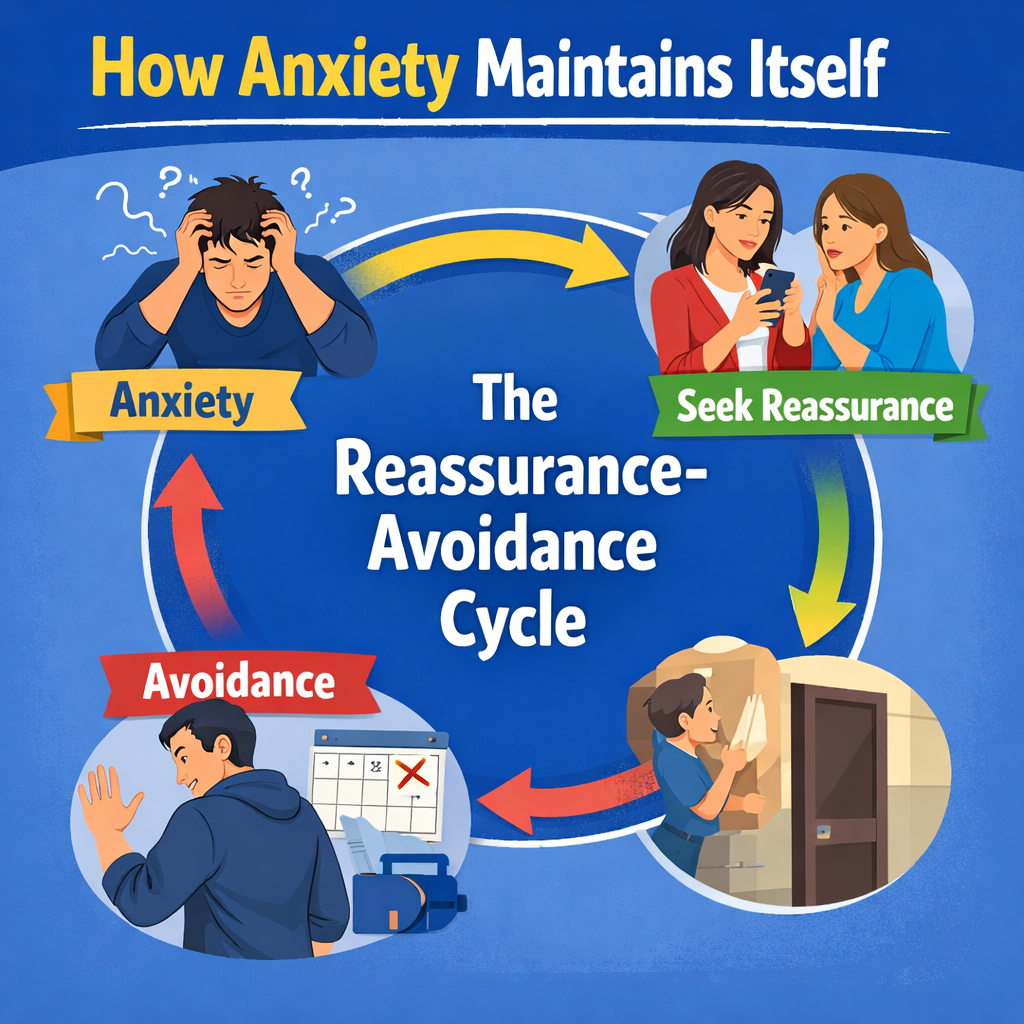
The reassurance-avoidance cycle is a common anxiety pattern.
It often looks like this:
-
Something feels uncertain, uncomfortable, or threatening.
-
Anxiety rises.
-
The person seeks reassurance or avoids the situation.
-
Anxiety drops for a short time.
-
The brain learns: “I escaped danger.”
-
The next time uncertainty appears, the anxiety returns even more quickly.
This cycle can happen in relationships, health anxiety, work stress, social anxiety, parenting worries, academic pressure, and everyday decision-making.
The pattern is understandable. No one seeks reassurance or avoids situations for no reason. These are attempts to feel safe. The problem is that short-term safety can teach the mind that it cannot cope without these habits.
What reassurance looks like
Reassurance is anything we use to reduce anxiety by getting confirmation that everything is okay.
It may look like:
-
asking the same question repeatedly
-
checking with others for validation
-
reading symptoms online again and again
-
needing repeated confirmation in relationships
-
replaying conversations and asking, “Do you think I upset them?”
-
checking whether a decision was the “right” one
Reassurance is not always external. Sometimes it is internal. A person may keep mentally reviewing, analyzing, or self-soothing through repeated thought loops.
In the moment, reassurance can feel relieving. But when it becomes a pattern, the brain starts to depend on it.
What avoidance looks like
Avoidance is not always dramatic either.
It can include:
-
putting off a difficult conversation
-
avoiding making a decision
-
cancelling a plan because of anxiety
-
avoiding uncertainty
-
not asking a question because the answer may be uncomfortable
-
distracting yourself so you do not have to feel what is coming up
Sometimes avoidance looks very functional. A person may stay “busy” instead of present. They may keep researching instead of deciding. They may postpone rather than refuse. It still serves the same purpose: to move away from discomfort.
Why these patterns keep anxiety going
Anxiety is often driven by intolerance of uncertainty.
When a person feels uncertain, their mind treats uncertainty as danger. Reassurance and avoidance offer immediate relief, so the brain learns:
-
uncertainty is unsafe
-
I need outside confirmation to calm down
-
I cannot handle discomfort without escaping it
Because relief follows the behavior, the behavior gets strengthened.
This is why anxiety can become repetitive. The person is not weak, irrational, or “doing it wrong.” Their nervous system has simply learned a loop: uncertainty leads to anxiety, anxiety leads to safety-seeking, safety-seeking brings relief, and relief reinforces the cycle.
A few everyday examples
Example 1: Relationship anxiety
You send a message and do not get a reply for a while. Anxiety rises. You start wondering:
-
“Did I say something wrong?”
-
“Are they upset?”
-
“Should I send another text?”
You ask a friend what they think. You reread the chat. You feel better briefly. Then the anxiety returns the next time someone replies late.
Example 2: Health anxiety
You notice a sensation in your body. Anxiety rises. You search symptoms online, check your body repeatedly, or ask multiple people whether it sounds serious. You feel reassured for a while. Then a new sensation appears, and the cycle starts again.
Example 3: Overthinking and decision anxiety
You need to make a choice. Anxiety rises. Instead of choosing, you keep researching, asking others, making lists, and thinking through every possible outcome. It feels responsible, but underneath it is often the hope that certainty will arrive before action is needed.
What helps break the cycle
The goal is not to force yourself to “stop being anxious.”
The goal is to gradually reduce your dependence on reassurance and avoidance as the only ways to feel safe.
1. Notice the pattern
Start by asking:
-
What am I anxious about right now?
-
Am I seeking clarity, or am I seeking certainty?
-
What am I doing to make myself feel safe in this moment?
2. Name the relief strategy
Are you:
-
checking?
-
asking?
-
avoiding?
-
postponing?
-
overthinking?
-
mentally rehearsing?
Naming the pattern helps you step out of automatic mode.
3. Tolerate a little more uncertainty
Instead of trying to eliminate discomfort immediately, practice staying with a manageable amount of not-knowing.
This might mean:
-
not sending the second text
-
delaying symptom checking
-
making the decision without one more round of reassurance
-
allowing yourself to feel unsure and still move forward
4. Focus on one next step
Anxiety often wants total certainty. Real life rarely gives it.
Try asking:
-
What is the next helpful step?
-
What can I do even if I do not feel fully certain?
5. Build trust in coping, not certainty
Recovery is not about guaranteeing that nothing bad will happen. It is about learning that you can cope with uncertainty without needing to escape it every time.
A compassionate reminder
These patterns are not failures.
They are attempts to feel safe.
The mind is not trying to harm you. It is trying to protect you with habits that once felt necessary. But over time, those habits can start to shrink your life, your confidence, and your ability to tolerate the normal uncertainty of being human.
Final thought
Anxiety is often maintained not only by fear itself, but by the patterns we use to get away from fear too quickly.
Reassurance can feel comforting. Avoidance can feel protective. But when they become automatic, they can quietly teach the brain that uncertainty is dangerous and that you cannot handle it.
Healing often begins when you stop asking, “How do I get rid of this feeling immediately?”
and start asking, “How do I stay with this moment differently?”
Relief is helpful.
But real recovery comes from building tolerance, flexibility, and trust in your ability to cope.