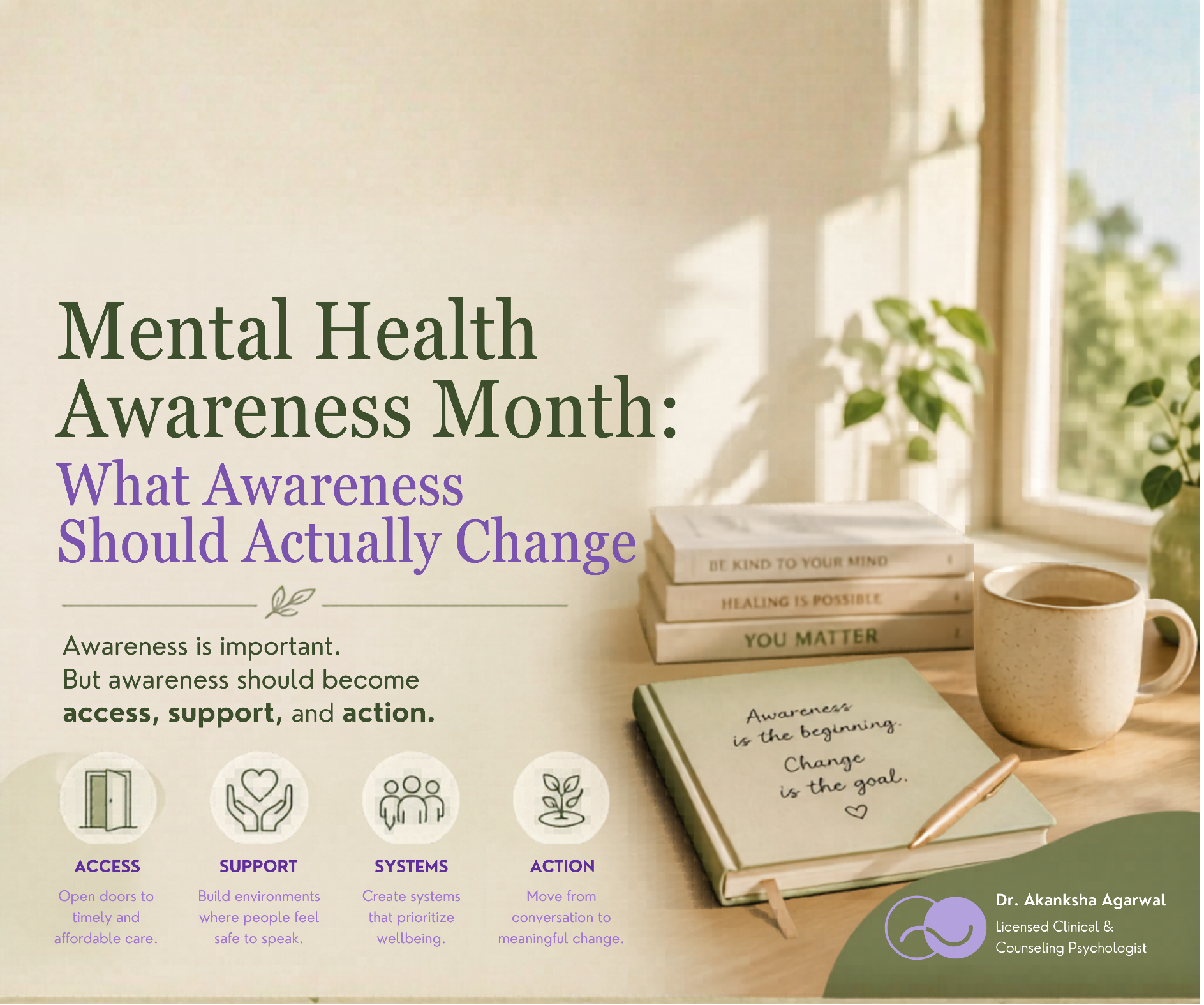
Mental Health Awareness Month: What Awareness Should Actually Change.
Mental Health Awareness Month is not only about talking more about mental health. Awareness should reduce stigma, improve access, strengthen support systems, and help people seek care before crisis.
Every May, we see more conversations about mental health.
Green ribbons.
Awareness campaigns.
Social media posts.
Workplace webinars.
School programs.
Reminders to “check in on people” and “take care of yourself.”
These conversations matter.
For many people, awareness can be the first moment they realize that what they are experiencing has a name. Anxiety. Burnout. Depression. Grief. Trauma. Emotional exhaustion. Stress. Loneliness. Overwhelm.
Awareness can reduce shame.
It can help someone say, “Maybe I’m not weak. Maybe I’m struggling.”
It can help families understand that mental health concerns are not character flaws.
It can help workplaces recognize that productivity without wellbeing eventually becomes unsustainable.
It can help schools see that emotional development is not separate from learning.
But awareness should not be the end goal.
Awareness should change something.
Awareness should change how we respond
When someone says, “I’m not okay,” the response matters.
Many people hesitate to speak up because they fear being dismissed, judged, advised too quickly, or told to “be positive.”
A more supportive response may sound like:
“I’m glad you told me.”
“That sounds heavy to carry.”
“Do you want me to listen, help you think through options, or support you in finding help?”
“You don’t have to explain everything perfectly for your distress to matter.”
Mental health awareness should make us better listeners.
Not perfect fixers.
Not instant advisors.
Not people who turn someone’s pain into a motivational quote.
Better listeners.
Awareness should change how early people seek support
Many people wait until they reach a breaking point before asking for help.
They may think:
“My problem is not bad enough.”
“I should be able to handle this.”
“Other people have it worse.”
“I’m still functioning, so I must be fine.”
“Therapy is only for crisis.”
But mental healthcare does not need to begin only when life has become unmanageable.
Support can be preventive.
Therapy, counseling, support groups, emotional education, healthy routines, and community support can help people earlier — before stress turns into burnout, before resentment damages relationships, before anxiety controls daily life, before emotional exhaustion becomes identity.
Seeking support early is not weakness.
It is emotional responsibility.
Awareness should change access
Talking about mental health is important. But if people cannot access support, awareness can feel incomplete.
Access includes many things:
affordable services,
trained professionals,
reduced stigma,
culturally sensitive care,
clear referral pathways,
school and workplace support,
community-based mental health education,
and safe spaces where people can speak without fear.
When awareness increases without access, people may know they need help but still not know where to go, whom to trust, or how to afford care.
Awareness should not only tell people to seek support.
It should help build pathways to support.
Awareness should change workplaces
Workplace mental health cannot be reduced to one wellness webinar.
A workplace that cares about mental health must also look at:
unrealistic workloads,
unclear expectations,
constant availability,
poor boundaries,
fear-based leadership,
lack of psychological safety,
and cultures where exhaustion is praised as dedication.
Burnout is not solved only by telling employees to meditate.
Rest matters. Mindfulness matters. Coping skills matter.
But if the environment continues to reward overwork and punish boundaries, awareness becomes performative.
Mental health awareness at work should change systems, not only individuals.
Awareness should change schools and families
Children and adolescents do not only need academic instruction.
They also need emotional language, safe adults, healthy boundaries, coping skills, and permission to speak about distress without being shamed.
Families also play a powerful role.
Mental health awareness should help families move away from:
“Stop overreacting.”
“Everyone has problems.”
“Don’t talk about these things outside.”
“You have everything, why are you sad?”
“Just be strong.”
And move closer to:
“Help me understand.”
“I may not fully get it, but I want to listen.”
“Your feelings are not a burden.”
“We can find support together.”
Awareness should make emotional conversations less frightening.
Awareness should change how we talk about strength
Many people have been taught that strength means silence.
Keep going.
Don’t complain.
Don’t need too much.
Don’t cry.
Don’t rest.
Don’t ask for help.
But real strength is not the absence of need.
Sometimes strength is saying:
“I need support.”
“This is affecting me.”
“I cannot keep doing this alone.”
“I need rest.”
“I need a boundary.”
“I want to understand myself better.”
Mental health awareness should expand our definition of strength.
Awareness should become action
Awareness is the doorway.
But it should lead somewhere.
It should lead to better listening.
Earlier support.
More accessible care.
Healthier workplaces.
Emotionally safer schools.
Less shame in families.
More informed conversations.
And systems that do not wait until people collapse before they are taken seriously.
This Mental Health Awareness Month, let us ask a deeper question:
Not only, “Are we talking about mental health?”
But also:
“What is changing because we are talking about it?”
Because awareness is important.
But awareness should become access.
Awareness should become support.
Awareness should become action.
And action is what creates more good days, together.
If this resonated with you, share it with someone who believes mental health awareness should move beyond conversation and become real support.