Depression Is More Than Sadness: Hidden Signs of Emotional Shutdown
Depression does not always look like obvious sadness. This article explores the quieter signs people often miss, including numbness, irritability, exhaustion, withdrawal, and the hidden forms of emotional shutdown.
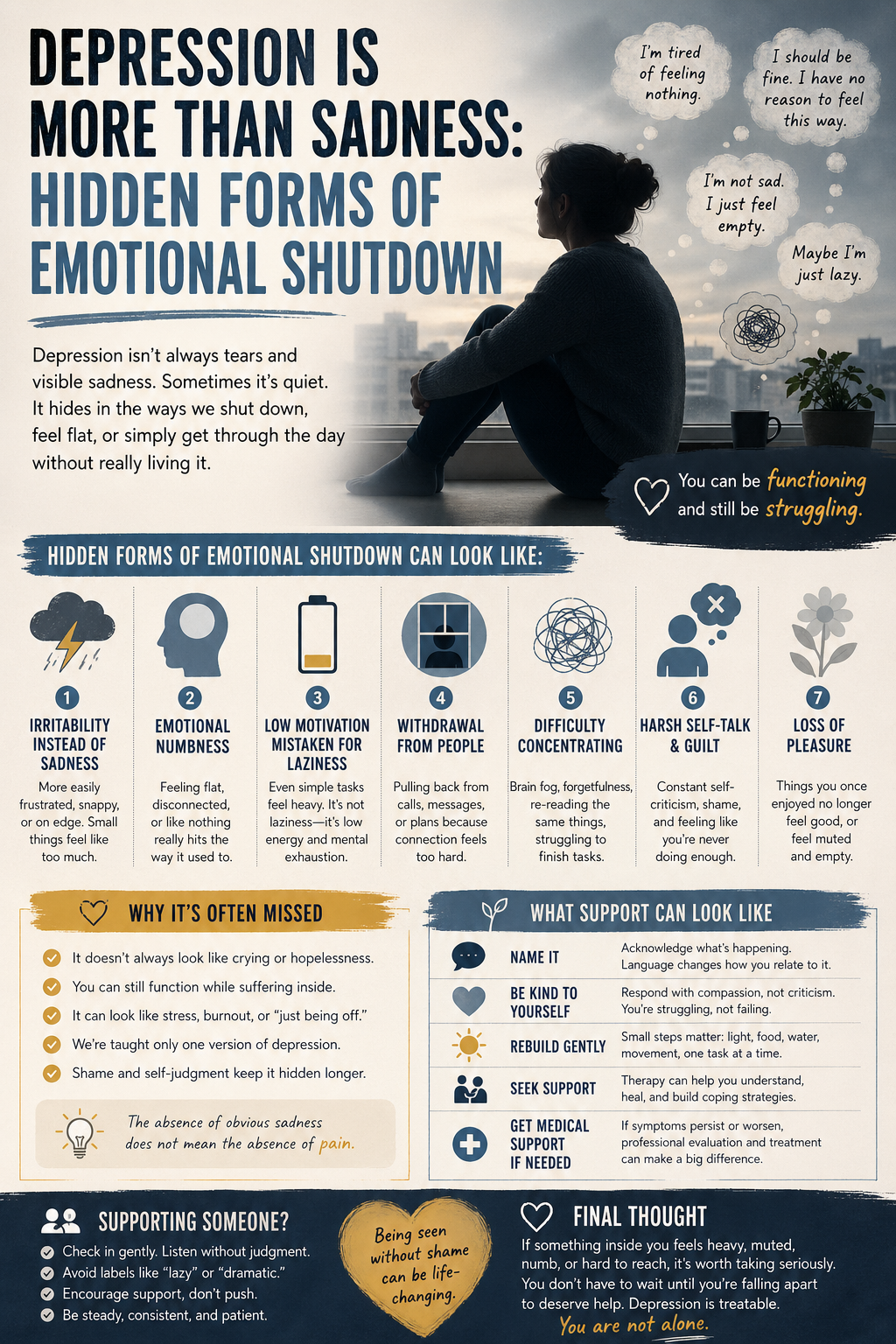
Depression Is More Than Sadness: Hidden Forms of Emotional Shutdown
When people think of depression, they often imagine visible sadness.
They picture someone crying frequently, looking obviously low, withdrawing from everything, or being unable to function. While that can certainly be one expression of depression, it is far from the only one.
In reality, depression is often missed because many of its forms are quieter, flatter, and less dramatic than people expect. Some people do not feel constantly sad. Instead, they feel empty. Numb. Irritable. Disconnected. Tired in ways they cannot quite explain. They may still be showing up, getting through work, taking care of responsibilities, and appearing “fine” from the outside.
That is part of what makes depression so misunderstood.
Depression is not always about visible emotional pain. Sometimes it is about emotional shutdown.
What emotional shutdown can look like
Emotional shutdown does not always mean the absence of feeling altogether. More often, it means that a person’s inner world has become heavier, flatter, less responsive, or harder to access.
A person may notice:
-
less joy
-
less emotional range
-
less spontaneity
-
less energy for connection
-
less interest in things that once mattered
They may still be moving through daily life, but with less inner engagement. Things begin to feel dulled. Meaning fades. Small tasks take more effort. Even pleasure becomes harder to reach.
This is one reason people often miss depression in themselves.
If they are not crying all the time, they may think:
-
“Maybe this is not serious.”
-
“Maybe I am just tired.”
-
“Maybe I am becoming lazy.”
-
“Maybe this is just stress.”
But depression can hide inside flatness just as much as it can inside sadness.
Why depression is often misunderstood
Many people are only taught to recognize one version of depression.
They are taught to look for obvious tearfulness, visible hopelessness, or complete inability to function. But depression is not always loud. Sometimes it is quiet and chronic.
It may look like:
-
getting irritated easily
-
withdrawing from messages and calls
-
feeling mentally slow or foggy
-
doing only what is necessary to get through the day
-
losing interest in people, work, or things you once enjoyed
-
feeling emotionally disconnected without fully understanding why
Because these experiences can resemble tiredness, stress, introversion, burnout, or “just being off,” depression often goes unnamed for longer than it should.
Hidden forms of emotional shutdown
Here are some of the less obvious ways depression may show up.
1. Irritability instead of visible sadness
Not everyone with depression looks soft or tearful.
Some people become more reactive, snappy, frustrated, or impatient. Small things feel too much. Noise feels unbearable. Questions feel intrusive. Everyday demands start to create a level of irritation that feels unlike them.
This can be especially confusing because irritability is often judged as attitude rather than recognized as distress.
A person may think:
-
“Why am I so short-tempered lately?”
-
“Why does everything irritate me?”
-
“Why do I feel constantly on edge?”
Sometimes that edge is not only stress. Sometimes it is depression showing up as reduced emotional capacity.
2. Emotional numbness
This is one of the most misunderstood experiences.
A person may say:
-
“I’m not exactly sad. I just don’t feel much.”
-
“I know I should care more, but I feel flat.”
-
“Things do not hit me the way they used to.”
Emotional numbness can feel frightening because people often interpret it as coldness, failure, or not caring enough. But in many cases, it is a sign that the system is depleted and emotionally shut down.
When emotional pain has been chronic or overwhelming, the mind sometimes stops responding in full color. Everything becomes muted.
3. Low motivation that gets mislabeled as laziness
Depression can significantly reduce the ability to initiate action.
This is why even simple things can begin to feel disproportionately hard:
-
getting out of bed
-
taking a shower
-
replying to a text
-
making food
-
doing one small chore
-
opening a laptop
-
making one basic decision
From the outside, these tasks may look small. But internally, they may require far more emotional and mental effort than people realize.
This is not laziness.
It is often low energy, reduced motivation, low mood, slowed thinking, and emotional heaviness all colliding at once.
4. Withdrawal from people
A person may start cancelling plans, replying less, avoiding calls, or pulling back from interaction.
This is often misunderstood as disinterest, attitude, or intentional distancing. But for many people, social withdrawal happens because they do not have the energy to be “on.” Connection starts to feel effortful. The idea of responding, explaining, or participating can feel like too much.
Sometimes isolation becomes a form of emotional protection.
Not because the person does not care, but because they do not have enough internal capacity.
5. Difficulty concentrating
Depression can affect attention, memory, processing speed, and mental clarity.
A person may notice:
-
rereading the same line again and again
-
struggling to start or finish tasks
-
forgetting simple things
-
feeling mentally slow
-
being present physically but not fully mentally
This can create secondary shame, especially in people who are used to being productive or sharp. They may start criticizing themselves even more, which deepens the distress.
6. Harsh self-talk and guilt
Many people with depression do not only feel low. They also become deeply self-critical.
Their inner dialogue may sound like:
-
“I should be doing better.”
-
“Why am I like this?”
-
“I’m wasting time.”
-
“I’m falling behind.”
-
“I have no reason to feel this way.”
This is one of the painful paradoxes of depression. The person is already struggling, and then their mind turns that struggle into evidence against them.
Instead of receiving their difficulty with understanding, they meet it with shame.
7. Loss of pleasure, not just presence of pain
One of the more telling signs of depression is not only feeling bad, but also losing access to what once felt good.
Things may no longer feel enjoyable in the same way:
-
music
-
hobbies
-
food
-
social connection
-
rest
-
achievements
The person may still do these things, but without much internal response. Life starts to feel muted.
This matters because depression is not always only about emotional pain. Sometimes it is about the loss of emotional reward.
Why people keep missing it in themselves
Many people delay recognizing depression because their distress does not match the version they have in mind.
They may think:
-
“I’m still functioning.”
-
“I’m not crying all the time.”
-
“I’m still going to work.”
-
“Other people have it worse.”
-
“Maybe I’m just tired.”
But functioning and suffering can coexist.
A person can still meet responsibilities while internally feeling disconnected, flat, exhausted, and emotionally shut down. That is part of why depression can stay hidden for so long, especially in high-functioning adults.
What support can look like
The good news is that depression does not have to be dramatic to deserve support.
You do not need to wait until you are completely overwhelmed before taking what you feel seriously.
Support can include:
1. Naming what is happening
Sometimes the first shift is simply moving from:
“I’m just lazy”
to
“Something feels heavy and I need to take that seriously.”
Language matters. It changes how you relate to your own experience.
2. Reducing self-judgment
Harsh self-talk often worsens depression.
Self-compassion does not mean pretending things are easy. It means responding to difficulty without turning it into a character flaw.
Instead of:
“Why can’t I just get over this?”
try:
“I’m struggling right now, and that matters.”
3. Rebuilding basic rhythms gently
When depression affects daily functioning, very small actions matter.
This may include:
-
getting out of bed and sitting near light
-
taking one shower
-
drinking water
-
eating something simple
-
walking for a few minutes
-
replying to one message
-
doing one task instead of ten
The goal is not perfect functioning. The goal is gentle re-entry into movement.
4. Seeking psychological support
Talking to a mental health professional can help make sense of what is happening, reduce shame, and create a plan that fits the person’s actual needs.
Support can help with:
-
identifying patterns
-
understanding triggers
-
addressing self-criticism
-
building coping strategies
-
restoring emotional connection over time
5. Considering medical evaluation when needed
If symptoms are persistent, significantly affecting functioning, or accompanied by major changes in sleep, appetite, hopelessness, or thoughts of self-harm, professional evaluation is important.
Depression is treatable, and support does not have to wait until things become severe.
How to support someone who may be shutting down
If you are supporting someone who may be depressed, try to remember:
Do not assume that if they are functioning, they are fine.
You can help by:
-
noticing changes without being intrusive
-
checking in gently
-
reducing judgment
-
not labeling them as lazy or careless
-
encouraging support without pressure
-
being steady, not forceful
Sometimes the most helpful thing is not solving everything. It is making it easier for the person to feel seen without feeling shamed.
Final thought
Depression is more than sadness.
Sometimes it looks like flatness.
Sometimes like irritation.
Sometimes like withdrawal.
Sometimes like exhaustion.
Sometimes like a person continuing to function while feeling less and less alive inside.
That is why depression deserves a wider lens.
The absence of obvious sadness does not mean the absence of pain.
And emotional shutdown is still suffering, even when it is quiet.
If something inside you has felt heavy, muted, numb, or harder to reach lately, it is worth taking seriously.
Not everything that looks like laziness, distance, or bad attitude is that.
Sometimes it is depression asking to be understood.